Bitcoin vs Ethereum and the Blockchain Trilemma
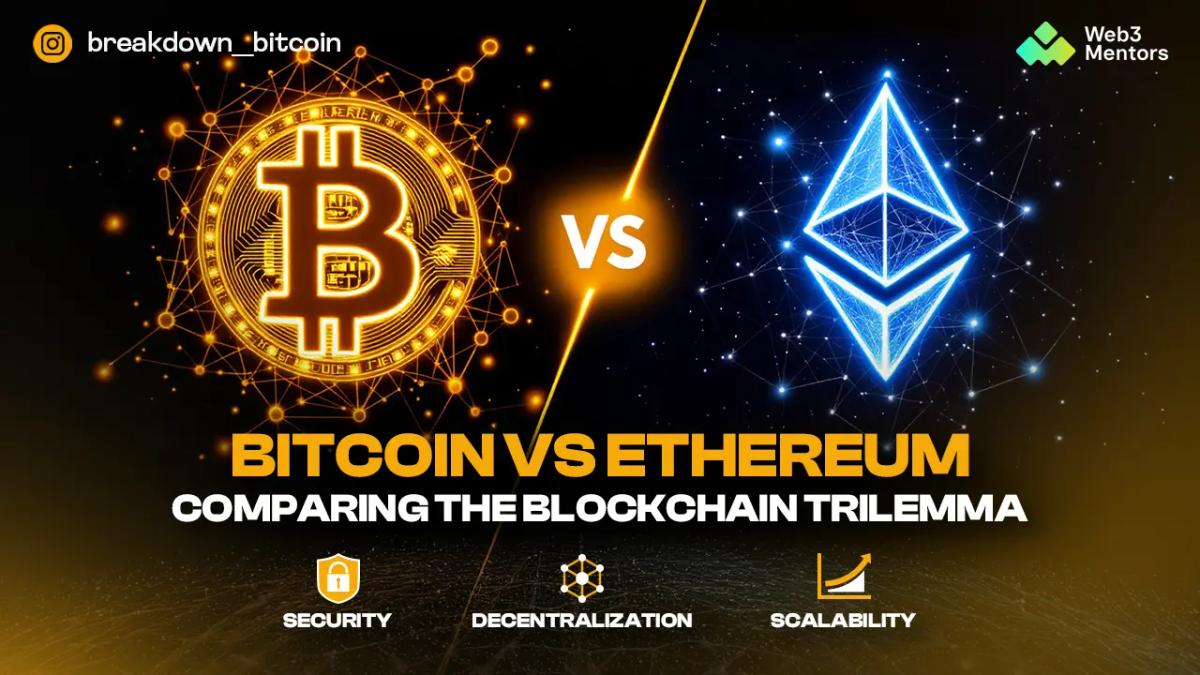
It’s not a fight, it’s a set of trade-offs
Bitcoin vs Ethereum is often framed as a competition, but that framing misses the point. These two networks are not trying to win the same game. They are optimizing for different priorities, and the differences become very clear when you look at the blockchain trilemma.
The trilemma says a blockchain can only strongly optimize two out of three things at once: security, decentralization, and scalability. Every design choice pushes against one of these corners. Bitcoin and Ethereum both accept this reality, they just make different compromises.
What the blockchain trilemma actually means
Security is about how hard it is to rewrite history or attack the chain. Decentralization is about how many people can realistically run nodes and verify the system themselves. Scalability is about how many transactions the network can process without congestion.
In theory, everyone wants all three. In practice, trade-offs are unavoidable. This idea shows up repeatedly in Mastering Bitcoin, where Andreas Antonopoulos explains that Bitcoin deliberately keeps its base layer simple so that anyone can verify it.
That choice has consequences.
Bitcoin chooses security and decentralization first
Bitcoin’s base layer is intentionally conservative. Block size is limited, block time is slow, and changes happen carefully. This isn’t accidental, it’s a design philosophy.
Every Bitcoin full node independently verifies blocks and transactions. No shortcuts. No trust assumptions. This is why running a node on consumer hardware is still possible more than a decade later.
At the code level, Bitcoin nodes always follow the chain with the most accumulated proof-of-work:
// From Bitcoin Core (simplified logic)
CChain& chain = chainActive;
if (newChainWork > chainActive.Tip()->nChainWork) {
    ActivateBestChain(state, pblock);
}
There is no voting, no committee, no coordinator. The chain with the most work wins. This simple rule is what makes Bitcoin extremely hard to attack.
The trade-off is scalability. Bitcoin can’t process thousands of transactions per second on-chain, and it doesn’t try to. Scaling happens off-chain through layers like the Lightning Network, which keeps the base layer minimal and secure.
Ethereum prioritizes flexibility and scalability
Ethereum started with a different goal. Instead of focusing only on sound money, it aimed to be a general-purpose execution layer for decentralized applications.
This decision changes everything.
Smart contracts require more computation, more state, and more frequent updates. As explained in Mastering Ethereum, this makes scalability harder at the base layer, which is why Ethereum has continually evolved its design.
Ethereum’s move to Proof of Stake reduced energy usage and enabled new scaling paths like rollups. Instead of pushing everything onto Layer 1, Ethereum now treats Layer 1 as a settlement and data availability layer.
Here’s a simplified look at how Ethereum clients execute transactions inside blocks:
# Simplified Ethereum transaction execution flow
state = StateDB()
for tx in block.transactions:
    apply_transaction(state, tx)
commit_state(state)
This flexibility enables DeFi, NFTs, DAOs, and complex applications but it also increases system complexity and introduces new trust and coordination assumptions.
Decentralization looks different on both networks
Bitcoin decentralization is measured by how many independent nodes can fully verify the chain without special hardware or large capital requirements. That number is high, and it matters.
Ethereum decentralization focuses more on validator distribution and economic security. While anyone can technically run a validator, the staking requirement and infrastructure complexity make it less accessible for casual users.
Neither approach is “wrong”. They just answer different questions.
Bitcoin asks: Can anyone verify the money?
Ethereum asks: Can anyone build on the system?
Security through simplicity vs security through economics
Bitcoin’s security comes from proof-of-work and simplicity. The protocol changes slowly, attack surfaces are limited, and incentives are well understood.
Ethereum’s security increasingly relies on economic penalties, validator behavior, and social coordination. Slashing, staking rewards, and governance all play a role.
Both systems are secure, but in different ways. Bitcoin minimizes trust. Ethereum manages it.
So who solves the trilemma better?
The honest answer is: neither solves it completely and that’s okay.
Bitcoin strongly optimizes for security and decentralization, accepting limited base-layer scalability. Ethereum pushes scalability and flexibility forward, accepting more complexity and coordination.
They don’t compete head-to-head. They occupy different lanes.
Bitcoin is the most secure, decentralized settlement layer ever created.
Ethereum is the most expressive, programmable blockchain in production.

Stay Updated
Subscribe to our newsletter for the latest updates on courses and...