Understanding Bitcoin Addresses
A simple guide for anyone curious about Bitcoin
Hey friends in the crypto world and also those who are just curious and trying to understand what Bitcoin actually is.
Today, let’s talk about one of the most basic, yet most important ideas in Bitcoin: the Bitcoin address.
You’ve probably heard phrases like “send it to this address” or “what’s your receiving address?” many times. But if someone asked you what a Bitcoin address really is, how it’s created, or why it works, the answer might feel a little unclear.
Don’t worry. Let’s take this step by step and remove the mystery.
What is a Bitcoin address?
At its core, a Bitcoin address is simply a receiving destination on the Bitcoin network.
You can think of it like a bank account number but with one important difference. A bank account is issued and controlled by a bank. A Bitcoin address is created by math, not by an institution.
When someone wants to send you bitcoin, they need your Bitcoin address. When you send bitcoin to someone else, you enter their address. That’s it.
A Bitcoin address is a string of letters and numbers, usually starting with 1, 3, or bc1, depending on the type of address being used.
Here’s a famous example:
1A1zP1eQp5fHzqUDgfdxYyKzXmpfCjU6c
This is the address used in the Bitcoin genesis block and is commonly associated with Satoshi Nakamoto.
Bitcoin addresses are public and that’s okay
One important thing to understand is that Bitcoin addresses are meant to be shared.
You can post your address online, send it in a message, or show it as a QR code. Anyone can send bitcoin to it. But no one can spend bitcoin from it unless they control the private key behind it.
An address does not give access.
It only defines who is allowed to unlock the funds later.
This is a key idea explained in Mastering Bitcoin: Bitcoin separates ownership from identity.
Where does a Bitcoin address come from?
This is where things get interesting and also where Bitcoin becomes elegant.
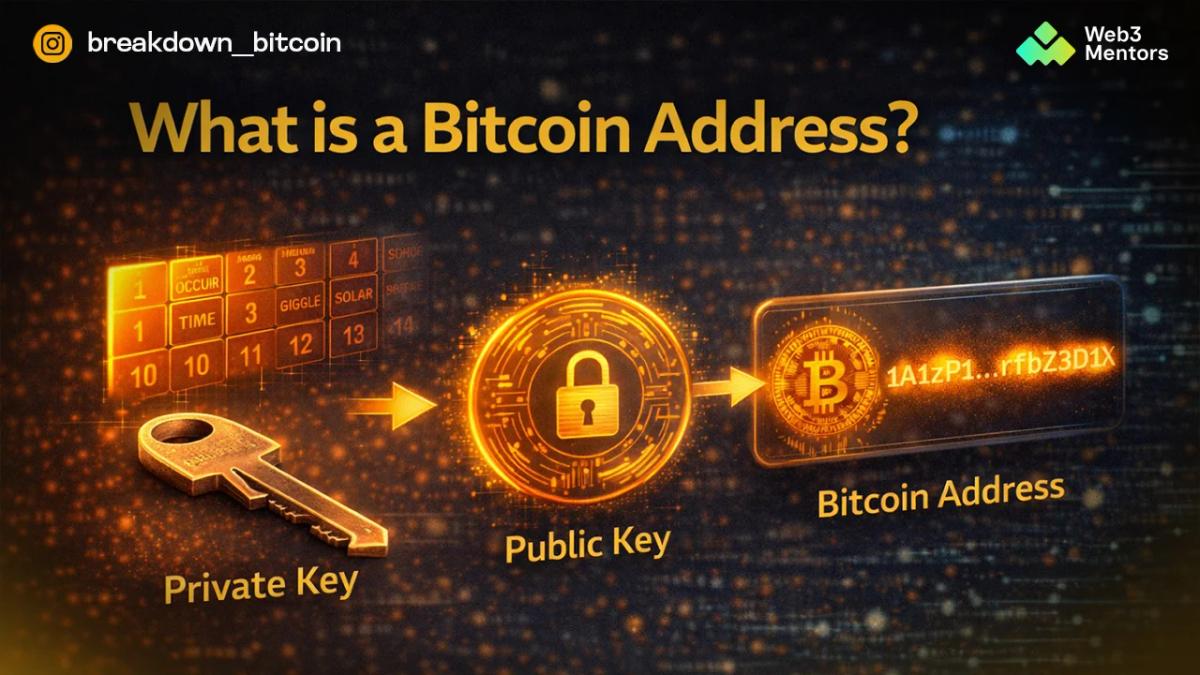
A Bitcoin address is not randomly assigned. It is derived, step by step, from something much more important: a private key.
A private key is just a very large random number. Whoever controls this number controls the bitcoin. Nothing else matters. Bitcoin doesn’t know your name or location, it only recognizes cryptographic proof.Most wallets don’t show private keys directly. Instead, they give you a seed phrase, usually 12 or 24 simple words.
As Andreas Antonopoulos explains:
This phrase is just a human-friendly backup that can regenerate all your private keys.
From that private key, Bitcoin mathematically generates a public key.
This step is one-way. You can always create a public key from a private key, but you can never reverse it. This is basic cryptography, the same kind used to secure the internet.
From Public Key to Bitcoin Address
The public key is still too long and inconvenient to use directly. So Bitcoin processes it further.
The public key is hashed and shortened using cryptographic hash functions. Error-checking information is added so mistakes can be detected. Finally, the result is encoded into a format humans can safely copy and share.
What you get at the end is a Bitcoin address.
So a Bitcoin address is not magic.
It’s not random.
It’s the final output of math protecting ownership.
Bitcoin doesn’t store coins, it stores rules
Another important idea from Mastering Bitcoin is this: Bitcoin does not store coins inside addresses.Instead, the blockchain records rules that say,
“These funds can only be spent by someone who can produce a valid signature for this address.”
When you spend bitcoin, your wallet creates a digital signature using your private key. Nodes on the network verify that signature against the address. If it matches, the transaction is valid. If not, it’s rejected everywhere.
No permission.
No trust.
Just verification.
Why Bitcoin addresses matter
Bitcoin addresses are one of the reasons Bitcoin works without banks, customer support, or intermediaries.
They allow anyone in the world to receive money securely, without revealing identity, and without asking for approval. The system doesn’t care who you are, it only cares whether the math checks out.
That’s why Bitcoin is so difficult to fake, copy, or manipulate.

Stay Updated
Subscribe to our newsletter for the latest updates on courses and...