Time-Locked Bitcoin Transactions: How You Can Lock Your BTC Until the Future
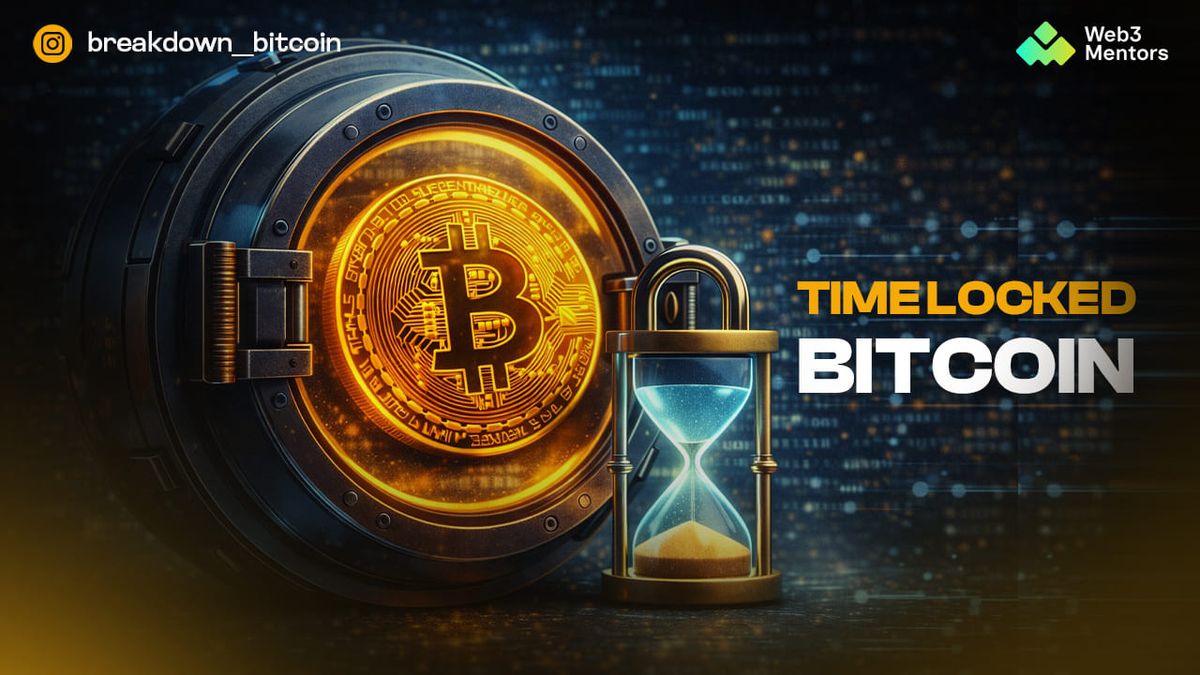
Time-Locked Bitcoin: Money That Obeys Time
Bitcoin is often described as hard money. Fixed supply. No central control. No bailouts. But there’s another powerful feature most people don’t talk about enough. Bitcoin can be locked in time.
You can send Bitcoin today that cannot be spent until a future date, even if you change your mind. No bank. No lawyer. No middleman. Just code enforcing your decision.
This is what makes Bitcoin not just money, but programmable money.
What Does “Time-Locked Bitcoin” Actually Mean?
A time-locked Bitcoin transaction is a transaction that includes a rule:
“This Bitcoin cannot be spent before a specific time or block.”
That rule is enforced by every Bitcoin node in the network. Miners will simply refuse to include the transaction in a block until the condition is met.
Even if you broadcast the transaction early, it will sit there doing nothing. No one can speed it up. No one can bypass it. Not even you.
This idea is built directly into Bitcoin’s protocol. It’s not a smart contract platform add-on. It has existed since the early days of Bitcoin and is described in detail in Mastering Bitcoin.
How Bitcoin Enforces Time Locks
Bitcoin understands time in two ways: block height and real-world time.
A transaction can say, “Do not allow this Bitcoin to be spent before block 900,000,” or “Do not allow this Bitcoin to be spent before January 1, 2030.”
This rule is written into the transaction itself. Every node checks it. If the condition isn’t satisfied, the transaction is invalid. Simple as that.
There is no trust involved. The network enforces the rule collectively.
This is what makes Bitcoin different from traditional finance. In banks, time locks are promises. In Bitcoin, time locks are math.
A Simple Example of a Time-Locked Transaction
In Bitcoin, time locks are implemented using a field called nLockTime.
Here’s a simplified example inspired by Mastering Bitcoin:
nLockTime = 1704067200
That number represents a Unix timestamp. In this case, it means the transaction cannot be confirmed before January 1, 2024.
Even if you sign this transaction today and broadcast it, miners will reject it until the time condition is met.
Bitcoin doesn’t care about your intentions. It only cares about rules.
Why Would Anyone Lock Their Own Bitcoin?
At first, this sounds strange. Why would you lock money away from yourself?
But once you think about it, the use cases are powerful.
Imagine long-term savings where you physically cannot panic sell. Imagine inheritance where funds unlock automatically for your children in the future. Imagine contracts where payment is guaranteed but delayed without needing trust.
This is money that forces discipline.
In a world driven by emotion and impulse, Bitcoin introduces something radical: commitment enforced by code.
Time Locks vs Trust
In traditional systems, delayed payments rely on people and institutions. Someone has to behave honestly. Someone has to follow the agreement.
Bitcoin removes that human layer.
Once a time-locked transaction is created, no one can change it. Not a government. Not a company. Not even the sender.
This is why Andreas Antonopoulos often emphasizes that Bitcoin doesn’t remove trust it minimizes the need for it.
Time locks are a perfect example of that philosophy.
Real-World Uses of Time-Locked Bitcoin
Time-locked transactions are not theoretical. They are already used today.
They power things like payment channels, escrow-like arrangements, inheritance planning, delayed salaries, and even advanced constructions like the Lightning Network.
Lightning, for example, relies heavily on time locks to make sure funds can be safely recovered if something goes wrong. Without time locks, Lightning simply wouldn’t work.
So when you hear “layer-two scaling,” remember: time-locked Bitcoin is one of the foundations.
Why This Is Next-Level Money
Most digital money can be frozen, reversed, or modified by someone in charge.
Bitcoin doesn’t work that way.
When you time-lock Bitcoin, you are creating a rule that even future you cannot break. That’s uncomfortable for some people. But that discomfort is exactly what makes Bitcoin powerful.
It turns money into something closer to physical law than human policy.
And that’s why time-locked Bitcoin feels different, It’s not just saving. It’s commitment, enforced by mathematics.

Stay Updated
Subscribe to our newsletter for the latest updates on courses and...