Why You Can’t Copy-Paste Bitcoin
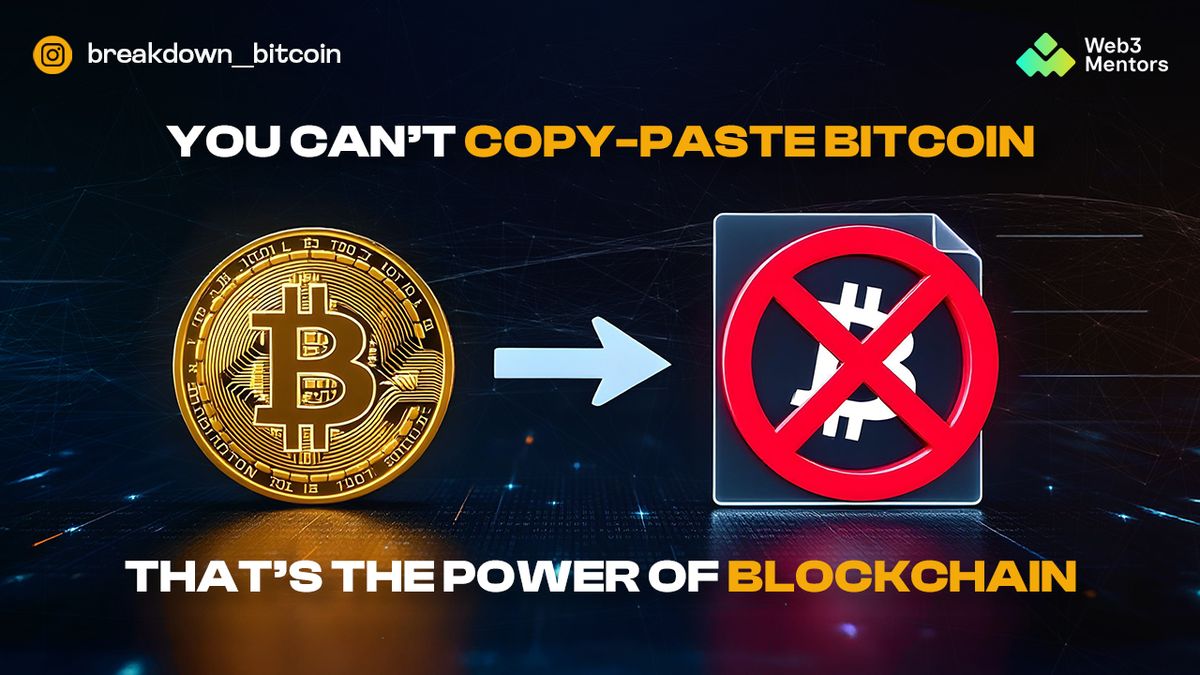
Why Bitcoin Feels Like Digital Cash, But Isn’t Copyable
At first glance, Bitcoin looks like just another digital file. Numbers on a screen. Lines of code. Something that lives on the internet. And if it’s digital, a fair question follows naturally: why can’t we just copy and paste it like a photo or a PDF?
That question haunted digital money experiments for decades before Bitcoin existed. Every attempt failed for the same reason. If digital money can be copied, it can be spent twice. And if it can be spent twice, it isn’t money at all.
Bitcoin is the first system that solved this problem without trusting a bank, a company, or a government.
The Old Problem: Digital Money and Double Spending
Before Bitcoin, digital money always relied on a central authority. PayPal, banks, credit cards and all of them keep a private ledger. When you send money, they update their database and make sure you didn’t send the same balance twice.
Without that central referee, digital value breaks. You could copy a file infinitely and send it to multiple people. This is known as the double-spend problem, and it’s the reason digital cash didn’t exist in a decentralized form before 2009.
Bitcoin didn’t remove this problem by hiding it. It solved it in the open.
Bitcoin Doesn’t Move Files, It Updates History
When you “send” Bitcoin, nothing is actually being copied or transferred like a file. What changes is ownership history recorded on the blockchain.
Bitcoin uses a public ledger where every transaction references previous transactions. Each coin is traceable through a chain of cryptographic signatures all the way back to its creation in a coinbase transaction.
This idea comes straight from the Bitcoin whitepaper:
“We define an electronic coin as a chain of digital signatures.”
If you try to copy your Bitcoin and spend it again, the network sees two conflicting histories. Only one can survive.
Proof of Work Decides Which History Is Real
So who decides which transaction is valid?
No one. And everyone.
Bitcoin miners collect transactions into blocks and compete using Proof of Work. The longest (more accurately, most-work) chain becomes the authoritative version of history.
If you try to double spend by copy-pasting Bitcoin, your fake version has no accumulated work behind it. Nodes reject it automatically.
This is why Bitcoin doesn’t need a central server to say “no.” The rules are enforced by math, energy, and consensus.
Here’s a simplified excerpt from Bitcoin Core showing how blocks are validated based on accumulated work:
bool CChain::SetTip(const CBlockIndex* pindex) {
    if (pindex == nullptr) {
        vChain.clear();
        return true;
    }
    vChain.resize(pindex->nHeight + 1);
    while (pindex && vChain[pindex->nHeight] != pindex) {
        vChain[pindex->nHeight] = pindex;
        pindex = pindex->pprev;
    }
    return true;
}
This chain structure is why you can’t invent your own version of Bitcoin and expect the network to accept it.
Scarcity Is Enforced, Not Promised
Bitcoin’s supply isn’t scarce because someone says so. It’s scarce because every node independently enforces the same rules.
There will only ever be 21 million bitcoin. You can’t copy more. You can’t inflate the supply. You can’t trick the ledger.
If you attempt to create Bitcoin out of thin air or duplicate existing coins, nodes reject your blocks instantly. Your version of reality simply doesn’t count.
This is fundamentally different from fiat money or digital bank balances, which can be expanded with a keystroke.
Why This Matters More Than Most People Realize
The inability to copy-paste Bitcoin is not a technical curiosity. It’s the entire breakthrough.
It means value can exist on the internet without permission. It means money can be native to the digital world without being controlled by intermediaries. It means scarcity, ownership, and final settlement can happen globally, 24/7, without trust.
Bitcoin isn’t just digital money. It’s digital property with physical-world constraints.
And that’s why, no matter how many times you try, Ctrl+C and Ctrl+V will never work on Bitcoin.

Stay Updated
Subscribe to our newsletter for the latest updates on courses and...